Berlinski’s The Devil’s Delusion Back in Print
Deepening Darwin’s Dilemma
The newly released film “Darwin’s Dilemma” argues that the geologically abrupt appearance of the major groups of animals (the “phyla”) in the Cambrian Explosion posed a serious problem for Charles Darwin’s theory of evolution (as he himself knew), and that subsequent fossil discoveries—far from solving the problem—have made it worse. In January 2009, however, the Journal of the Geological Society, Read More ›

Blown Away
Intelligent Design Film to Premiere at Sam Noble Oklahoma Museum of Natural History Sept. 29
Film Examines the Cambrian Explosion, Biology’s Big Bang, 530 Million Years in the Past
The Constitutionality of Academic Freedom Legislation
In this excerpt from a longer law review article, attorney Casey Luskin examines the constitutionality of academic freedom legislation that would protect the rights of teachers and students to examine both the scientific strengths and weaknesses of modern evolutionary theory. Download the article now.
A Review of Hitler’s Ethic: The Nazi Pursuit of Evolutionary Progress
Over at Evolution News, Joshua Youngkin has written a review of Richard Weikart’s new book Hitler’s Ethic: The Nazi Pursuit of Evolutionary Progress:
Read More ›In his most recent book, Hitler’s Ethic: The Nazi Pursuit of Evolutionary Progress, Discovery Institute fellow Richard Weikart lays out a historian’s case for the proposition that Adolf Hitler’s murderous policies arose from a scientific racism inspired by Charles Darwin’s most famous ideas.
Signature in the Cell
Students Challenged to Study Evolution, Think for Themselves
This article, published by The Christian Post, quotes Casey Luskin of Discovery Institute: As students step foot on campus for another school year, an intelligent design proponent has offered a few tips for the millions who will face the teaching of evolution in their science classrooms. Tip number one, “never opt out of learning evolution,” says Casey Luskin, co-founder of Read More ›
Conservation of Information in Search
Abstract: Conservation of information theorems indicate that any search algorithm performs, on average, as well as random search without replacement unless it takes advantage of problem-specific information about the search target or the search-space structure. Combinatorics shows that even a moderately sized search requires problem-specific information to be successful. Computers, despite their speed in performing queries, are completely inadequate for resolving even moderately sized search problems without accurate information to guide them. We propose three measures to characterize the information required for successful search: 1) endogenous information, which measures the difficulty of finding a target using random search; 2) exogenous information, which measures the difficulty that remains in finding a target once a search takes advantage of problem-specific information; and 3) active information, which, as the difference between endogenous and exogenous information, measures the contribution of problem-specific information for successfully finding a target. This paper develops a methodology based on these information measures to gauge the effectiveness with which problem-specific information facilitates successful search. It then applies this methodology to various search tools widely used in evolutionary search.
Read More ›A “Heretic” in Jewish Terms? Someone Who Denies Intelligent Design
Last week some readers of this blog had a hard time accepting that the rabbinic term “apikoros,” a kind of heretic, denotes someone who rejects — if I may use the contemporary term — intelligent design. One fellow, by a rigorous Google search, even believed he’d found Internet-based proof that an apikoros designates a Christian! Um, no. The Mishnah uses Read More ›

Expelled From the New York Times
My sister nailed it many years ago when she said, “Your basic human is not such a hot item.”
Keep that filed in your head as I tell my little tale.
About five or six years ago, roughly, I was solicited to write a column every two weeks for the Sunday New York Times Business Section. I was really thrilled. I have written for the Washington Post (when I was a teenager), for the Wall Street Journal edit page under the legendary Bob Bartley, for Barron’s, under the really great Alan Abelson and Jim Meagher, for my beloved American Spectator, under the great Bob and Wlady, and now having a regular column at the Times was going to be great stuff.
The column went well. I got lots of excellent fan mail and fine feedback from my editors, who, however, kept changing.
The first real super problem I had was when the movie I narrated and co-wrote, Expelled — No Intelligence Allowed, was in progress. A “science writer” for the Times blasted the movie on the front page and noted that I, whom she repeatedly called “…a freelance writer…” (not a columnist) for the Times, was somehow involved. That was followed by a really fantastically angry blast against the movie by a reviewer who really hated it a lot. (I note that the Times also disliked Ferris Bueller’s Day Off. Hmm.)
Expelled was a plea for open discussion of the possibility that life might have started with an Intelligent Designer. This idea, that freedom of academic discussion on an issue as to which there is avid scientific disagreement has value, seems obvious to me. But it drives the atheists and neo-Darwinists crazy and they responded viciously.
Read More ›New Video Shows DNA Evidence for Intelligent Design

Samurai Bioethics
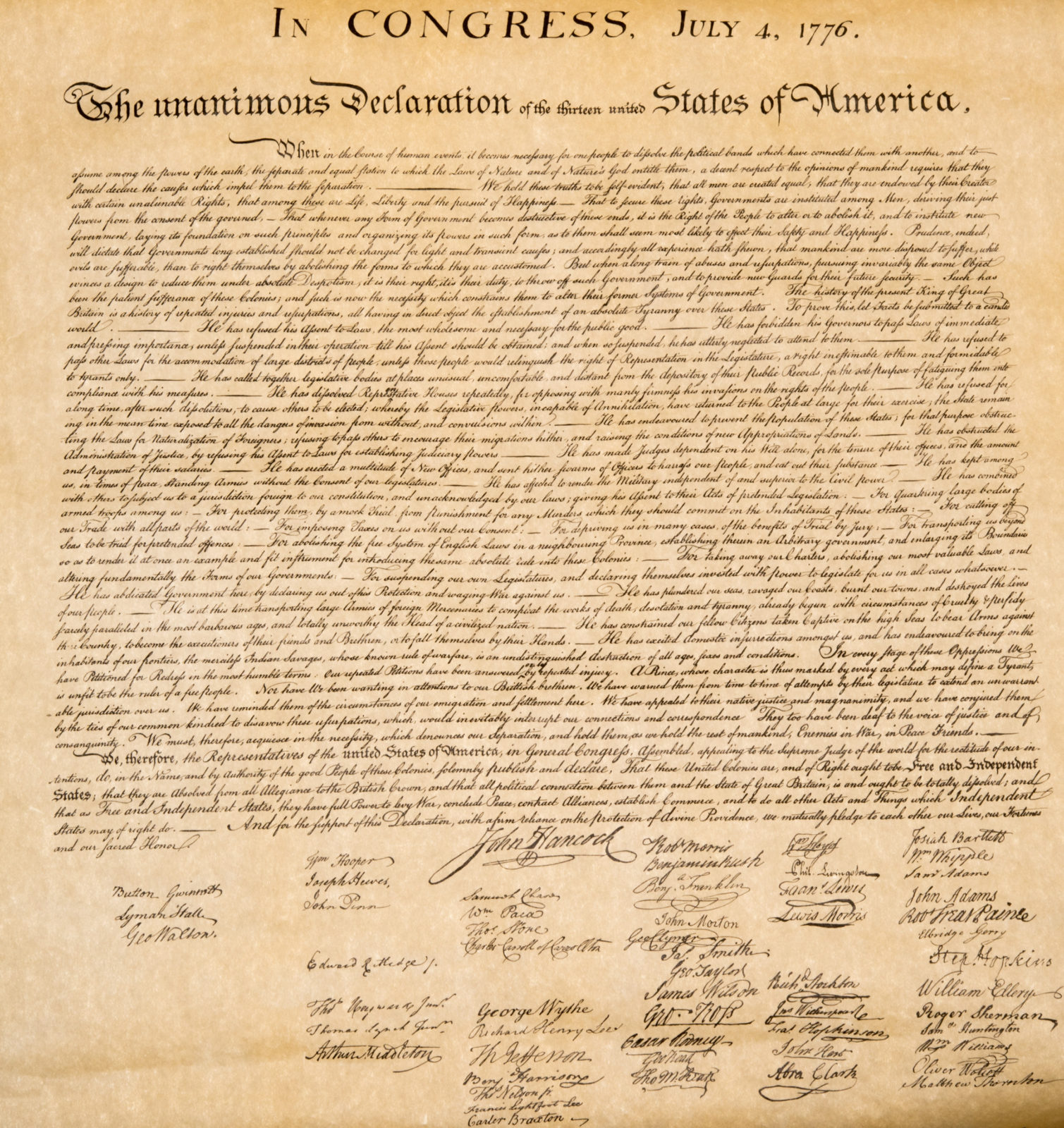
Did Founding Father Thomas Jefferson Support Intelligent Design?
In the battle over how to teach evolution in public schools, Thomas Jefferson’s demand for a “separation between church and state’’ has been cited countless times. Many argue that the controversial alternative to Darwinian evolution, intelligent design, is an exclusively religious idea and therefore cannot be discussed under the Constitution. By invoking Jefferson’s principle of separation, many critics of intelligent Read More ›
Collins Appointment May Stir Unexpected Controversy
The President’s nomination of former Human Genome Project head Francis Collins to lead the National Institutes of Health must have seemed like a felicitous decision at the White House. Collins lately has been a popular speaker on science and religion around the country, assuring Christians that there is no problems linking faith in God and faith in Darwinian evolution. But Read More ›
Breaking the Cease-Fire Between Science and Religion
What is portrayed as the debate between religion and science feels increasingly like watching the very bitter dissolution of a doomed marriage. The relationship started out all roses and kisses, proceeded to doubts and regrets, then fights and silences, a mutually agreed separation, and finally to curses and maledictions: “I wish you were dead!” In a recent Wall Street Journal Read More ›
The Alphabet of Life
DNA are three letters full of paradox. What they represent remains little understood by the public, yet they are on everyone’s tongue. Amid the chatter of popular culture, the truth gets lost that DNA is one of the most powerful clues we have of the existence of a spiritual reality, maybe to the existence of God. An acronym for deoxyribonucleic Read More ›
Dr. Stephen Meyer on Michael Medved Show
Meyer and Medved discuss the information revolution and the challenge it presents for Darwinism, as well as the argument for intelligent design from information. Click here for the interview.