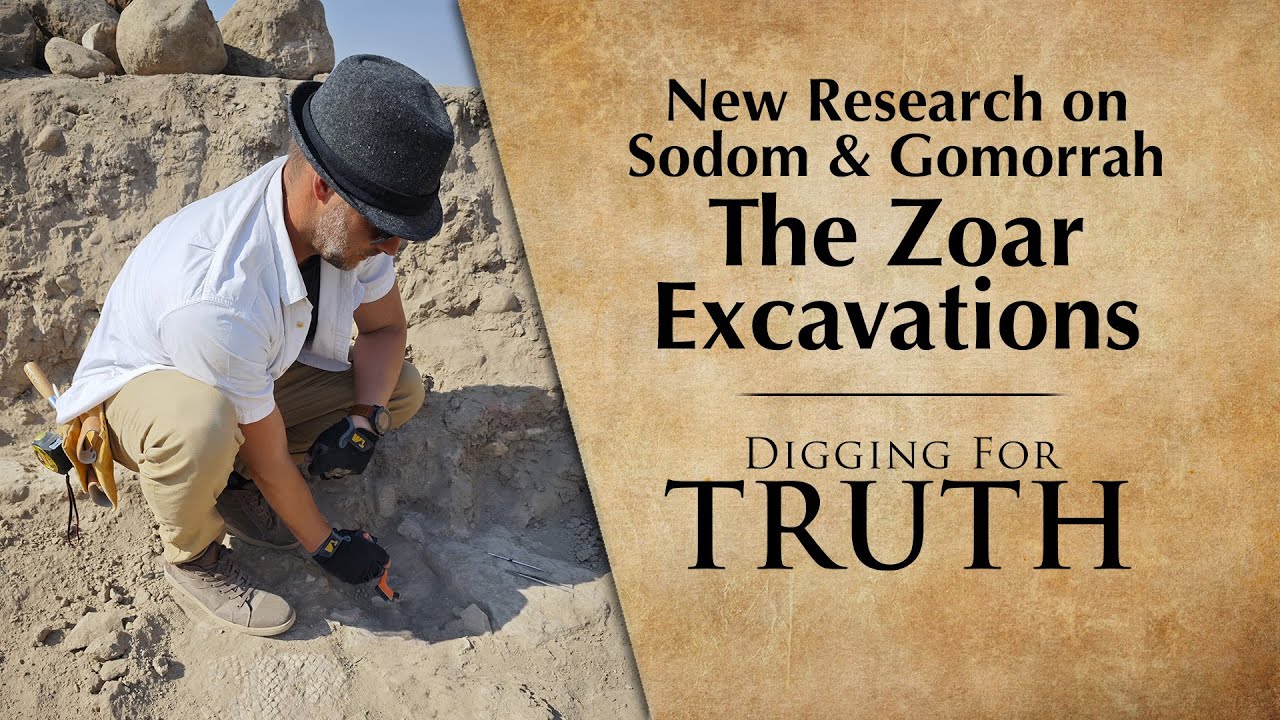
New Research on Sodom and Gomorrah with the Zoar Excavations
View at YouTubeThis video is a two-part episode from “Digging for Truth” featuring archaeologist Dr. Titus Kennedy discussing new archaeological research on the biblical city of Zoar and its relationship to Sodom and Gomorrah.
Biblical Background
Zoar (also called Bela) was one of the five “cities of the plain” mentioned in Genesis, along with Sodom, Gomorrah, Admah, and Zeboiim. According to the biblical narrative, Zoar was described as a “little one” and was located close enough to Sodom that Lot could flee there overnight when destruction came. Uniquely among the five cities, Zoar was not destroyed and continued to be inhabited through ancient times.
Archaeological Evidence for Zoar’s Location
Kennedy presents multiple lines of evidence pointing to Zoar’s location on the southeastern side of the Dead Sea in the Safi area:
- The Madaba Map (542 AD) shows Zoar on the southeastern Dead Sea
- Ancient written sources from Josephus (1st century) through Byzantine pilgrims consistently place it in this region
- A Roman military fort mentioned in 4th-century sources has been discovered and excavated near the site
- Byzantine tombstones of military officers and a bishop named Opsis (dated 369 AD) were found in the cemetery
Lot’s Cave
Near Zoar, archaeologists discovered a Byzantine church built around a cave with inscriptions identifying it as associated with Lot. Significantly, pottery found inside the cave dates to the Early Bronze Age and beginning of Middle Bronze Age — matching the timeframe of Abraham and Lot — after which the cave ceased to be used for millennia. This supports the traditional identification of the location.
Current Excavations at Zoar
Kennedy served as field director for recent excavations at Zoar. The team has uncovered extensive Byzantine-period remains including two large churches, confirming this was an important early Christian city. Excavation probes beneath the Byzantine layers have revealed Nabatean habitation (1st century) and Bronze Age pottery sherds, confirming occupation during the biblical period. A Bronze Age cemetery and settlement adjacent to the Byzantine city have also been identified.
Candidate Sites for Sodom and Gomorrah
Kennedy discusses Bab edh-Dhra as a strong candidate for Sodom. This site is the largest of five Early Bronze Age cities in the southeastern Dead Sea region, was destroyed by fire, and was never reoccupied — matching biblical descriptions. The cemetery contains hundreds of thousands of graves, and excavators found that charnel houses were burned from above, with fire starting on roofs and burning downward into burial chambers.
Numeira is presented as a candidate for Gomorrah, with linguistic connections between the names. Like Bab edh-Dhra, it was destroyed by massive fire during the Early Bronze Age and never reoccupied. Human skeletal remains were preserved under a collapsed tower.