
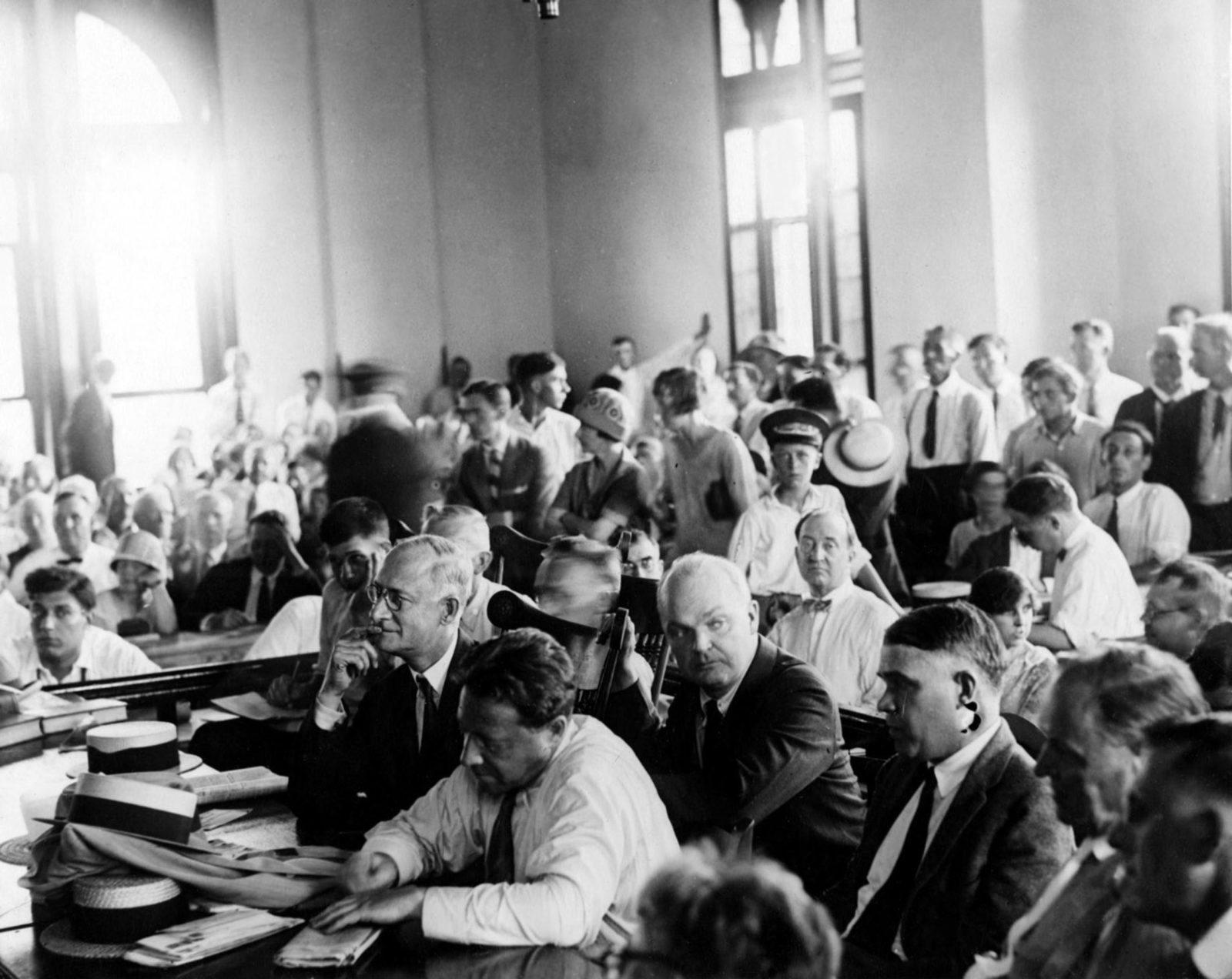
Debunking the Scopes ‘Monkey Trial’ Stereotype
Whenever a challenge to the truth of Darwinian evolution arises, the scientific establishment and its allies trot out the Scopes Monkey Trial. It is their position that if the scientific establishment has ratified a science textbook, such as the book from which Scopes taught evolution, the state should not engage in “censoring” the material in that book.
The Scopes Monkey Trial plays such a prominent role in the debate that I purchased a copy of the transcript; a copy of the textbook from which Scopes taught, A Civic Biology; and a copy of the companion lab guide to that textbook. Review of these source materials-very different from the biased picture presented in Inherit the Wind-was a real eye-opener.
In the Scopes trial, there was never any judgment or verdict that Darwinian evolution is true. The prosecution argued and the judge agreed that the Tennessee statute in question barred the teaching of the Darwinian theory even if it were true, so its truth was not an issue in the case. Nor, notably, was the truth of the theory of Darwinian evolution and the supposed evidence for it ever subjected to cross-examination. Scopes’ lawyers presented extensive written statements from seven scientists stating that Darwinian evolution is the correct explanation for the diversity of life on earth. The prosecution sought permission to cross-examine the five pro-Darwinian science experts whose statements had been read in open court, but Clarence Darrow and the other Scopes lawyers objected and the court refused to allow it.
Read More ›
A Scientific History and Philosophical Defense of the Theory of Intelligent Design
A Brief History of Intelligent Design
Unfortunately, in his Kitzmiller v. Dover ruling, Judge Jones bought into the revisionist history of ID that claims ID is just repackaged creationism, and the Judge presented a sharply truncated and inaccurate view of the intellectual history of design. A correct history will make it clear that “intelligent design” was not a term invented to avoid the Edwards ruling, but Read More ›
The History of Science and Religion in the Western Tradition

Copernicus Stages A Comeback
More than sixty years after the famous Galileo “The Earth it Moves” trial in Rome, Copernicus is in the news again, this time in the form of a so-called theory of universal gravitation (or UG, as it has come to be known). Headquartered at the Royal Society, a think tank in London funded by well-heeled royalist donors, members of the Read More ›

Encyclopedia Entry on Intelligent Design
Intelligent design begins with a seemingly innocuous question: Can objects, even if nothing is known about how they arose, exhibit features that reliably signal the action of an intelligent cause? To see what’s at stake, consider Mount Rushmore. The evidence for Mount Rushmore’s design is direct — eyewitnesses saw the sculptor Gutzon Borglum spend the better part of his life Read More ›

Unintelligent Designs on Academic Freedom
It’s been an unusual week in the academy. The academic freedom that so incensed Bill Buckley as a student at Yale decades ago is now acting to protect a conservative scholar under fire. Baylor’s J.M. Dawson Institute for Church-State Studies hired Francis Beckwith as its Associate Director last summer. Although previously known as a philosopher who had developed powerful critiques Read More ›

The Meanings of Evolution
“Evolution and the theories of evolution are fundamentally different things,” testified zoologist Maynard M. Metcalf, the first expert witness for the defense in the 1925 Scopes trial. Metcalf’s observation at the “trial of the century” officially marked the beginning of public discussion of the different meanings of evolution for the purposes of science education. “The fact of evolution is a …
Inherit the Wind
You know the story, the play, the movie–all based on a piece of American history. It starts when a high school biology teacher in a small, rural American community begins teaching his classes about a theory of mans origins that defies conventional beliefs. The teacher asks his students to examine the fossil record and draw their own conclusions. He traces Read More ›

DNA and Other Designs
For two millennia, the design argument provided an intellectual foundation for much of Western thought. From classical antiquity through the rise of modern science, leading philosophers, theologians, and scientists — from Plato to Aquinas to Newton — maintained that nature manifests the design of a preexistent mind or intelligence. Moreover, for many Western thinkers, the idea that the physical universe Read More ›