Foreign Policy

uk flag gov building
flag of UK on government building
Image Credit: Iakov Kalinin - Adobe Stock

Why Not a Free-Trade Pact With the U.K.?

The most embarrassing moment I had as a congressman from the 1st District of Washington was in the 1980s when I paid a visit to the then-British ambassador to the U.S., Sir Antony Acland. At a time back in the 80s when the U.S. was considering a free-trade agreement with Mexico and Canada, I suggested a free-trade agreement between the Read More ›

Prince of Wales Churchill Roosevelt Meeting Public Domain

The EU Threatens America and Britain’s Alliance. Brexit Could Save It.

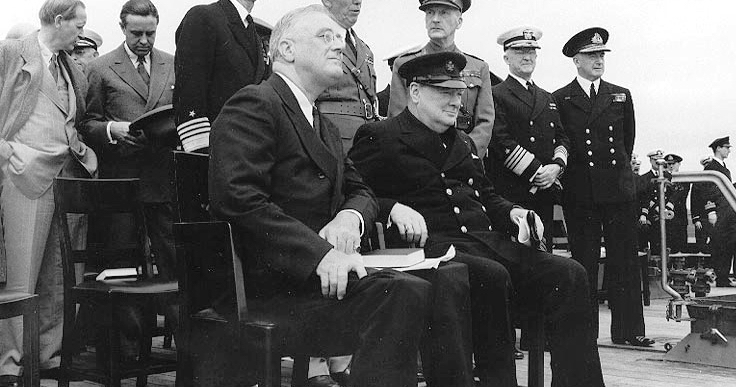
The close cooperative and beneficial alliance between the United States and the United Kingdom is now threatened in a way that it has not been since Churchill and Roosevelt stood together in the sunshine of the North Atlantic in 1941. What menaces this alliance? Read More ›
king-s-church-international-671136-unsplash
Photo by King's Church International on Unsplash

The European Union: An Un-Democratic Leviathan That Britain Might Just Escape

America’s closest ally, Great Britain, stands on the brink of a profound decision, one that could determine whether it remains the free, prosperous democracy that has worked closely with the United States since World War II, or goes on morphing into something much smaller and sadder. Read More ›
nicole-wilcox-456630-unsplash
Photo by Nicole Wilcox on Unsplash

2016: The West’s Last Chance — Last Gasp?

Behold recent developments: the moral inversion elevating Hamas over Israel, skewered by Dennis Prager (4:12); the fascism of militant Islam; insanely strict rules of engagement that tie our hands in battle; Miss Puerto Rico suspended from the Miss Universe pageant for an anti-Muslim online rant; rampant political correctness describing as “peaceful or moderate” Muslims who take offense at those who link Islam to terrorism; the government questioning the loyalty of an Read More ›

Will Our Values Make Us Seek Peace With Genocide?

When Prime Minister Benjamin Netanyahu said that Hitler got the idea of perpetrating the Holocaust from Haj Amin al-Husseini, as Grand Mufti of Jerusalem from 1922 to 1948 spiritual leader of the Arabs in Palestine, he predictably ignited a firestorm. In fact, as this Israel Network video (4:56) shows, the mufti’s role in the Nazi genocidal enterprise was that of eager collaborator Read More ›

Rocks on Rosh Hashanah: Golda Was Right

Begin with yesterday’s bombshells: Palestinian Authority President Mahmoud Abbas gave a 40-minute address to the UN General Assembly. He declared Palestine a state — a statement of zero legal effect but of political significance. He announced that: (a) September 30 would henceforth be known (to Palestinians) as Palestinian Flag Day; (b) the Palestinians were no longer bound by the Oslo Accords. Specifically, Abbas Read More ›

From Barbary to the Gulf: Corsairs Then and Now

In 2007, two years before he became Israeli Ambassador to the U.S., Michael Oren penned a magisterial history of America’s long involvement in the Middle East, which goes back to within a decade of America’s founding. In Power, Faith, and Fantasy: America in the Middle East: 1776 to the Present, Oren shows that not only was America involved in what then Read More ›

Iran: New Canary, Old Tale, Dark Secrets

Recently the Wall Street Journal reported that while nearly 99 percent of Syria’s 1,300 metric tons of chemical munitions declared in 2013 have been destroyed, stocks of undeclared agents remain—even more lethal than those declared. To anyone familiar with arms control compliance history this should come as no surprise whatsoever. Inspectors entered only sites the Assad regime designated, fearing that otherwise they Read More ›

Fateful Fortnight of Denial

A fortnight overseas brought sunshine on the lovely Greek Isle of Naxos and gustatory classics in Provence, all enjoyed with stellar companionship of friends old and new. But in the background were ominous events that augur ill for global and domestic stability. In the forefront was the declaration of bankruptcy by Greece’s far-leftist populist president, backed by a rousing 60 Read More ›

Finding the First Amendment

A draw-Muhammad cartoon contest is staged in Garland Texas. Two ISIS terrorists show up with automatic weapons intending to massacre the assemblage. A single guard guns them down with a pistol, narrowly averting mass carnage. The post-attack response, even including conservative stalwarts, is to condemn not just the would-be assassins, but the speakers and the cartoons presented at the conference. Read More ›

16600670420_ecdc19916c_o
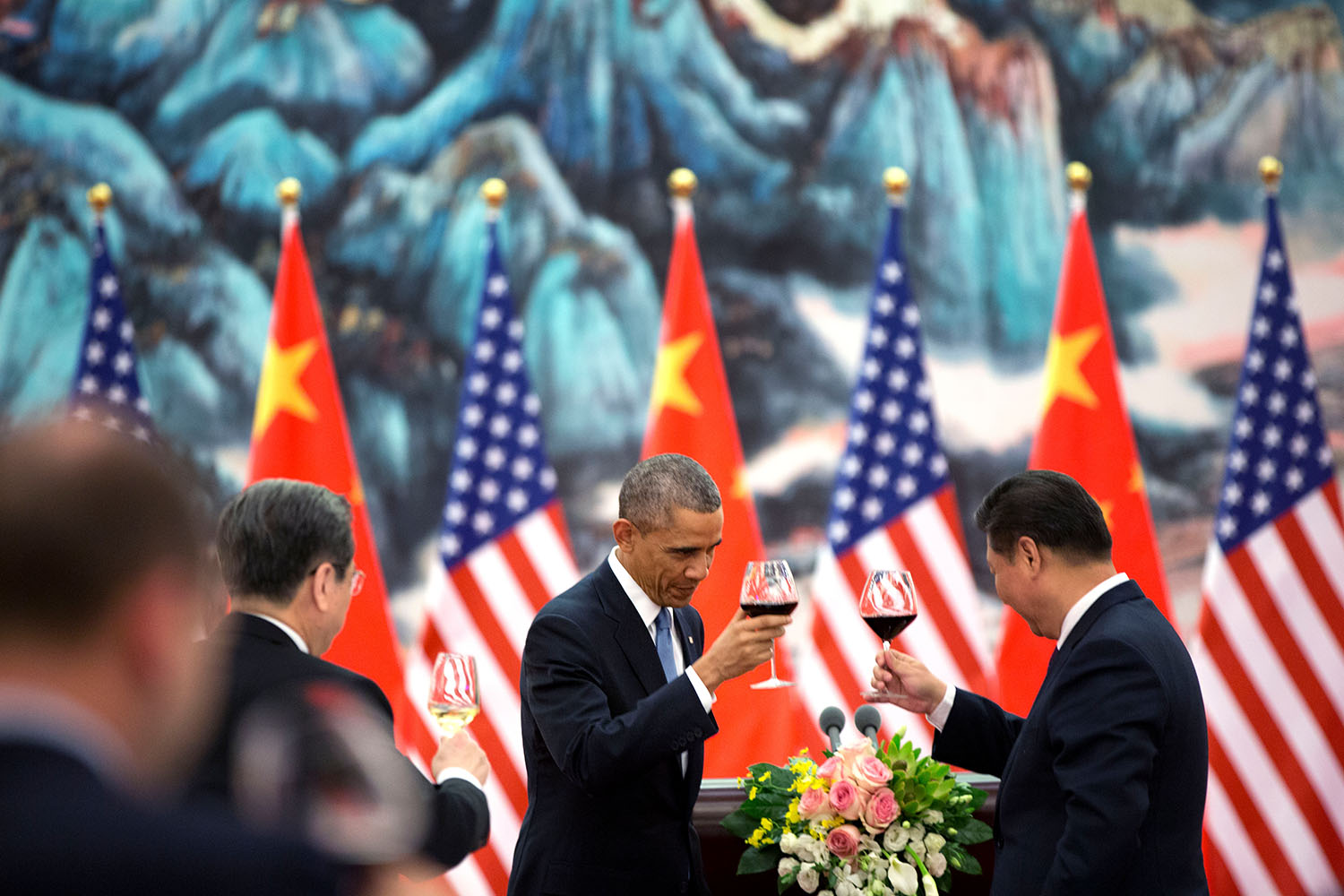
President Barack Obama offers a toast to President Xi Jinping of China during a State Banquet at the Great Hall of People in Beijing, China, Nov. 12, 2014. (Official White House Photo by Pete Souza)
This official White House photograph is being made available only for publication by news organizations and/or for personal use printing by the subject(s) of the photograph. The photograph may not be manipulated in any way and may not be used in commercial or political materials, advertisements, emails, products, promotions that in any way suggests approval or endorsement of the President, the First Family, or the White House.
Official White House Photo by Pete Souza

A Tale of Two Cynics: Nixon and Obama

President Richard Nixon’s historic gamble with Mainland China turned out well. When he was elected in 1968, it was an out-of-control society and regime, subverting its neighbors and condemning the United States. Today we have a similar regional foe — Iran. Will President Obama be in Tehran a year from now, celebrating the start of a similar moderation by the world’s chief sponsor of terrorism? Or will he have rewritten yet another campaign pledge ushering in an Islamist nuclear power with apocalyptic ambitions?

The Nixon/Obama parallels are instructive. Richard Nixon was, and Barack Obama is, a loner with many admirers and few friends. Both preferred to speak to the electorate in heavily scripted settings. Both were lawyers. Both were also charged — nearly every week — with violating the Constitution. Both tolerated substantial cuts in U.S. military spending while inflating social-welfare and environmental obligations.

And both did whatever they had to do to appeal to a consistent enemy of the United States and its key allies.

One-Man Leadership Assaults the Conventional Wisdom

In October 1967, Communist (or Mainland) China was offered a deal by private-citizen Richard Nixon. Writing inForeign Affairs, he called for “a policy of firm restraint [and] creative counter-pressure designed to persuade Peking that its interests can be served only by accepting the basic rules of international civility.” Longer run, that meant “pulling China back into the world community — but as a great and progressing nation, not as the epicenter of world revolution.”

In 2008, presidential candidate Obama pledged to meet with Iran’s theocrats and cited no preconditions. Although not “carrot and stick” like Nixon’s, it was also a big gamble.

In 1969 — President Nixon’s first year — the Soviet Union proposed that the U.S. and U.S.S.R conspire to eliminate Mainland China’s nuclear forces. Nixon said back to the Kremlin: Don’t even think about it. In 2009 — President Obama’s first year — a fraudulent presidential election kept Iran’s extreme Islamists in power. Thousands took to the streets. Obama gave them zero support.

Forty years apart, Nixon and later Obama sent early and strong signals: “Count on the new guy to head off anything that will rock your boat….”

By 1972, Nixon was breaking bread with mass-murderer Mao Tse-Tung. The joint communiqué said “all Chinese on either side of the Taiwan Strait maintain there is but one China and Taiwan is a part of China.” Rather than seek repeal of the 1955 Sino-American Mutual Defense Treaty with Taiwan — then as now the “Republic of China” — Nixon pretended it did not exist. Traditional Republicans faced shell-shock.

Read More ›

Obama’s Iran Deal: The SALT Precedents

President Obama’s decision to avoid congressional scrutiny of his emerging nuclear deal with Iran led 47 GOP senators to write a letter warning Iran – and the president – that the Senate expects to be consulted.  A subsequent bipartisan letter signed by 367 members of the House of Representatives also urged the president to consult Congress.  A look at major Read More ›