Stephen Meyer on PBS’s ThinkTank
This film in two parts features Stephen Meyer and Michael Ruse on PBS’s ThinkTank in 2006, hosted by Ben Wattenberg. Used with permission. Part I Part II
This film in two parts features Stephen Meyer and Michael Ruse on PBS’s ThinkTank in 2006, hosted by Ben Wattenberg. Used with permission. Part I Part II
This film is Part 2 of the full episode featuring Stephen Meyer and Michael Ruse on PBS’s ThinkTank in 2006, hosted by Ben Wattenberg. Used with permission. See part 1 here. Part I
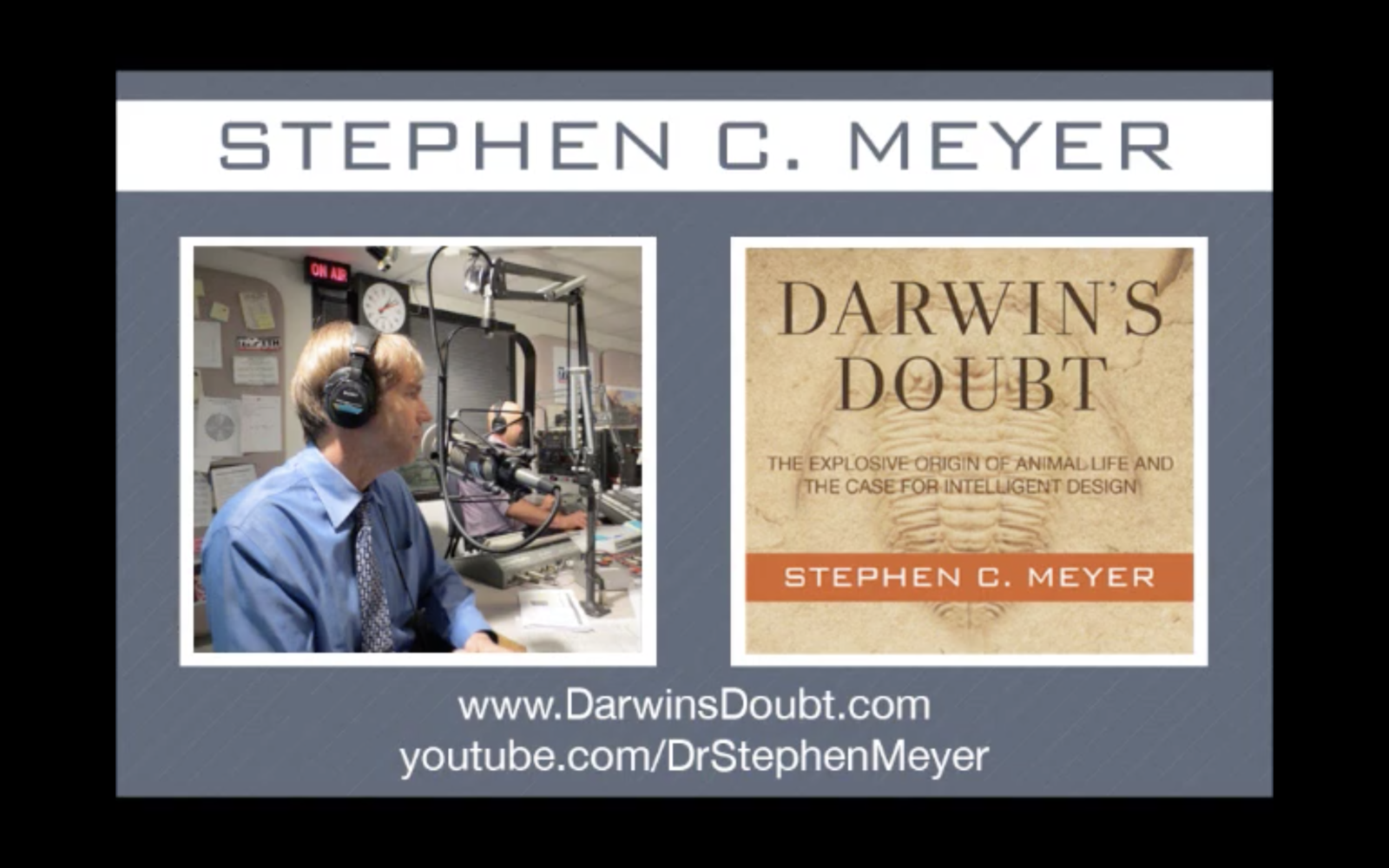
In this audio feature, Michael Ruse engages Dr. Stephen Meyer’s in a lively discussion about Meyer’s new book Darwin’s Doubt: The Explosive Rise of Animal Life and the Case for Intelligent Design on public radio’s Interfaith Voices. For more information on the book and to order your copy visit http://www.darwinsdoubt.com.
Intelligent Design: William A. Dembski & Michael Ruse in Dialogue Edited by Robert B. Stewart Fortress Press, 2007, 257 pages Despite—or perhaps because of—the great volume of books published annually on Darwinian evolution and intelligent design, few new contributions are worth the time of those familiar with the major works of Dawkins and Gould, Johnson and Dembski. (Recent exceptions to Read More ›
Dear Readers, Today I give you one last response for now, to Michael Ruse’s review of Edge of Evolution. After more reviews are in, I’ll compose a comprehensive response. I leave you with this for now. Michael Ruse in The Globe and Mail Michael Ruse is a philosopher of biology who has written over a dozen books on aspects of Darwinian thought. Read More ›

A response to “Darwinism: Philosophical Preference, Scientific Inference, and Good Research Strategy” by Michael Ruse, Darwinism: Science or Philosophy, Chapter 2, Proceeding of symposium entitled Darwinism: Scientific Inference or Philosophical Preference (March 26-28, 1992). I appreciate very much the opportunity to respond to Professor Ruse. Though it is in the nature of a response to disagree, I must say that Read More ›
The AAAS Board Resolution on intelligent-design theory represents the scientific establishments latest effort to insulate evolutionary biology from critique and discussion. The challenge of intelligent design for evolutionary biology is real. This is not like someone who claims that ancient technologies could not have built the pyramids, so goblins must have done it. We can show how, with the technological Read More ›
This article appeared in a discussion on the topic of intelligent design published in the July/August, 2002 issue of Research News & Opportunity In Science And Theology. Other contributoring thinkers included Karl Giberson, Michael Ruse, Eugenie Scott, William Dembski, Robert Pennock, and Jonathan Wells. If nothing else, Michael Ruse has chutzpah. Let me tell a little story about blood clotting, Read More ›
Science, we are told, is tentative. And given the history of science, there is every reason for science to be tentative. No scientific theory withstands revision for long, and many are eventually superseded by theories that flatly contradict their predecessors. Scientific revolutions are common, painful, and real. New theories regularly overturn old ones, and no scientific theory is ever the Read More ›