information theory

The Information Enigma

The Information Enigma

Information drives the development of life. But what is the source of that information? Could it have been produced by an unguided Darwinian process? Or did it require intelligent design? The Information Enigma is a fascinating 21-minute documentary that probes the mystery of biological information, the challenge it poses to orthodox Darwinian theory, and the reason it points to intelligent Read More ›

Gilder

George Gilder Joins Team Gold And Explains Where Friedman Went Wrong

My goodness! I honestly believe that today’s team of Classical monetary intellectuals is probably the best since about 1910. The long era of monetary ignorance, that characterized the 20th century, is finally passing. That team is strengthened now by the powerful intellect of George Gilder, who recently released a monograph entitled: The 21st Century Case for Gold: A New Information Theory of Money. Read More ›

The Tang Problem

The Tang Problem

Materialism says that everything is an organized complexity of matter, a bottom up perspective on our world. Dembski uses Tang to describe the problem with this view: You can take orange juice and extract orange juice ‘solids’ (orange juice powder), but you can never fully recreate orange juice again; yet that is what materialism attempts to do.

Information All the Way Down

Information All the Way Down

In this clip, William Dembski discusses information realism, the notion that the fundamental “stuff” of the world is information — not matter. An example of this is found in the recent search for the Higgs boson particle. The scatter diagram that “defined” the Higgs boson is essentially information — one pattern to the exclusion of others.

Conversations with William Dembski - Inspired by Richard Dawkins

How Richard Dawkins Inspired my Work on Intelligent Design

In this clip, William Dembski discusses how his work on intelligent design is largely inspired by famous atheist Richard Dawkins. Dembski found Dawkins’ The Blind Watchmaker “insightfully wrong,” and actually based his work on trying to answer some of the issues it raises. For more information about William Dembski, or to purchase his new book Being as Communion, visit www.beingascommunion.com.

Relation to Previous Work

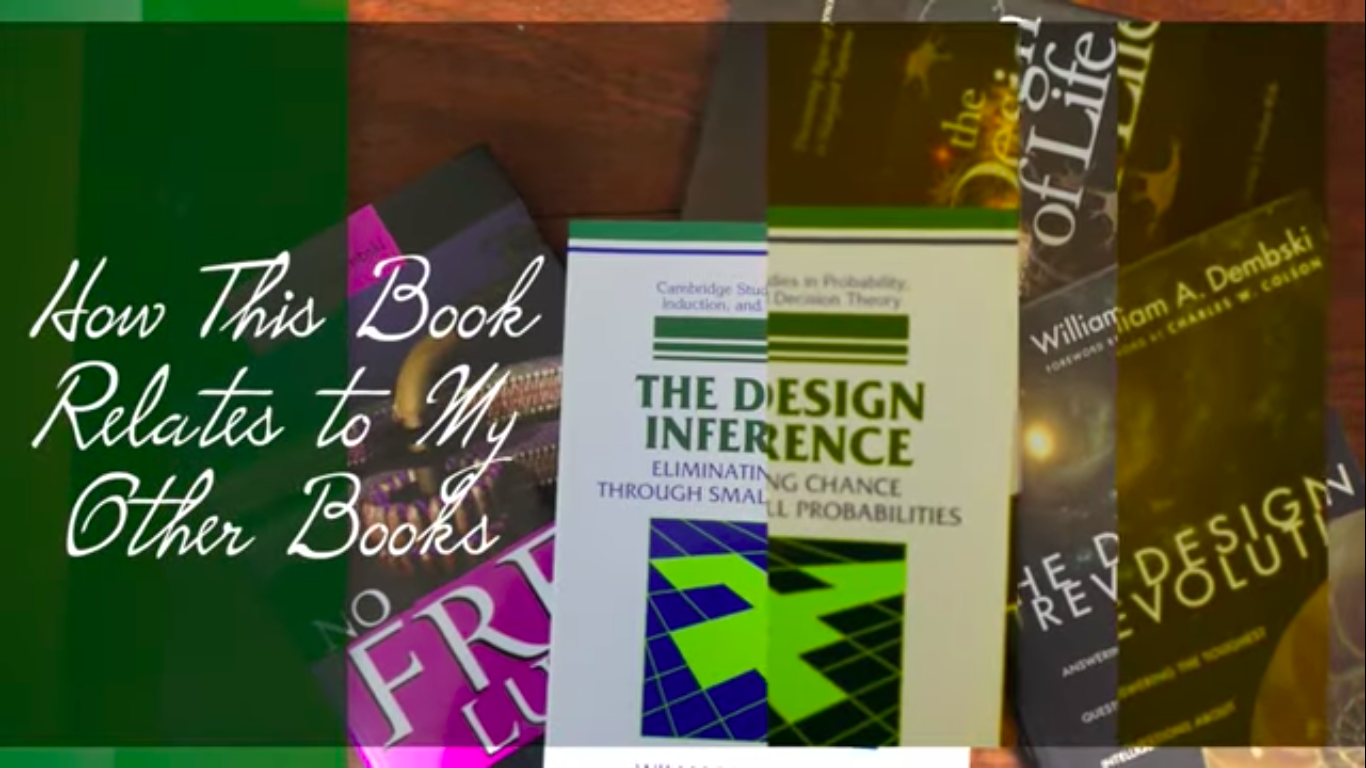
Being as Communion in Relation to Previous Work

In this clip, William Dembski describes how his new book Being as Communion fits with the other books he has written. In Being as Communion Dembski creates a metaphysical backdrop or worldview that challenges the traditional materialistic framework, therefore adding context to his previous work.

conversations-william-a-dembski

The Meaning of Information

In this clip, Dr. Dembski discusses the meaning of information. Dembski defines information as the “ruling out of possibilities.” By ruling a range of possibilities, you learn something. You can do science with this because you can start applying probabilities and measuring information.

diploma-william-a-dembski

A Fact Most People Don’t Know About William Dembski

In this clip we learn that Dr. William Dembski received his high school diploma after having received his PhD. Watch the video to hear the story. To Learn more about William Dembski, or his new book Being As Communion, visit www.beingascommunion.com.

Meyer Responds to Critics - Marshall

Meyer Responds to Critics: Marshall, Part 3

Stephen Meyer discusses his radio debate with Charles Marshall. The debate was very substantive and addressed a number of topics related to the Cambrian explosion including the validity of self-organizational processes as an explanation for the Cambrian explosion. For more information about Stephen Meyer and his New York Times bestseller Darwin’s Doubt, visit www.DarwinsDoubt.com.

The Thesis of Being as Communion

Conversations with William Dembski — The Thesis of Being as Communion

In this video Dr. William Dembski describes the central thesis of his new book Being as Communion. Dembski proposes that the fundamental “stuff” of this universe is information, not matter. Listen to Dembski discuss the nature of reality, relational ontology, the creation of information, and more. Being as Communion is a title that I came up with as I was Read More ›

chips and stock indices
dice and casino chips on a stock market chart
Image Credit: Tyler Olson - Adobe Stock

For Your Information

This article, published by American Spectator, provides a review of Discovery Institute Senior Fellow George Gilder’s book Knowledge and Power.


George Gilder has done it again. Nobody ventures out onto the cutting edge of technology to bring back its wonderful news than the sage of Tyringham, Massachusetts who, thirty years after inspiring the Reagan Administration with Wealth and Poverty, is still vigorously preaching the gospel of creative capitalism.

In Knowledge and Power, Gilder has absorbed the teachings of Claude Shannon, John von Neumann, Alan Turing — names most people wouldn’t recognize — who derived the mathematics of Information Theory in the 1940s and 1950s that created the world of ever-increasing contacts and networking we inhabit today.

As if that weren’t enough, Gilder has drawn all this abstruse theory into a seamless web that illustrates once again why capitalism and free enterprise are the critical element of creating a prosperous society while socialism and Obamism are a dead hand on the jugular of the economy that can only produce the dispirited and ever-more-malevolent stagnation we see now.

You see, it’s all a matter of INFORMATION.

Read More ›
climbers on wall
couple of athletes climber moving up on steep rock, climbing on artificial wall indoors. Extreme sports and bouldering concept
Image Credit: xartproduction - Adobe Stock

George Gilder Is Optimistic That We’re Due For A Surprising Leader

We’re not doomed. At least not according to George Gilder’s challenging and insightful Knowledge and Power.

Plenty of nations have lost their way, and this present distress is not the first time we’ve gotten off course. But according to Gilder, although human beings are wired to receive information, we are currently starved of new ideas because our current ruling class in politics and media is basically just transmitting the same old noise. According to Gilder, when politicians try to match their message to ‘public opinion’ they stultify the political process. The job of leaders is not to reflect back ghostly images of the already spectral enough phantom known as public opinion. The job of leaders is to teach the public something they don’t already know. The third and final installment of our interview with Gilder follows below:

Jerry: “I kind of imagine you speak this signal into the current intellectual milieu and the libertarians say, “Wait, what’s all this stuff about family?” And the sort of nostalgic right say, “Wait, what are all these new jobs from overseas? They’re going to mess up American culture.” I mean, you’re at odds, to some degree, with the sort of religious right nostalgists, “let’s keep everything 9-5”, lunch bucket kind of thing. You’re also at odds with the libertarians who want to redefine family and redefine the traditional moral code—“

George: “Those are fair statements.”

Jerry: “On the other hand, you are, I think, creating a new intellectual structure in which those divergent elements can be reunited, almost reuniting the Reagan coalition on information theory.”

George: “Yeah, I think so. That’s really the purpose of it; it’s to show that both sides are right, it’s to put freedom on a more secure foundation and to put constitutional government and political leadership on a better foundation. I mean, all the heroic inventions of entrepreneurs on the frontiers of science are ultimately dependent on the discipline, moral codes, and leadership by politicians and leaders and ministers and priests, and the whole body of people defending the low-entropy carriers are also indispensable to the high-entropy creators.”

Jerry: “So, we await a new political entrepreneur not to wait for the public to understand this on his own, but to take this message that reunites the Reagan coalition and go out and actively teach it and create a demand for the supply of these answers in the political sphere.”

George: “I think that’s right. And I’m very optimistic. You know, the good thing about a knowledge economy, an economy of mind, is that it can change as quickly as people’s minds can change. In my book, Knowledge and Power, there’s a whole chapter full of examples of countries that have radically transformed their economies in weeks once policies have been changed. From the United States, we’ve reduced government spending 61% in two years after the second world war, with the Republican Congress of 1946. We cut tax rates all over the place through the joint tax return. We dismantled all the regulatory apparatus of the wartime, and much of the new deal. All Keynesian economists thought that the result would be a catastrophe, Paul Samuelson said it would be the worst disruption and disaster and depression in the history of economics. Instead, we launched what’s now looked back on as a golden age of American economic progress.”

Read More ›