Stephen C. Meyer

Director, Center for Science and Culture

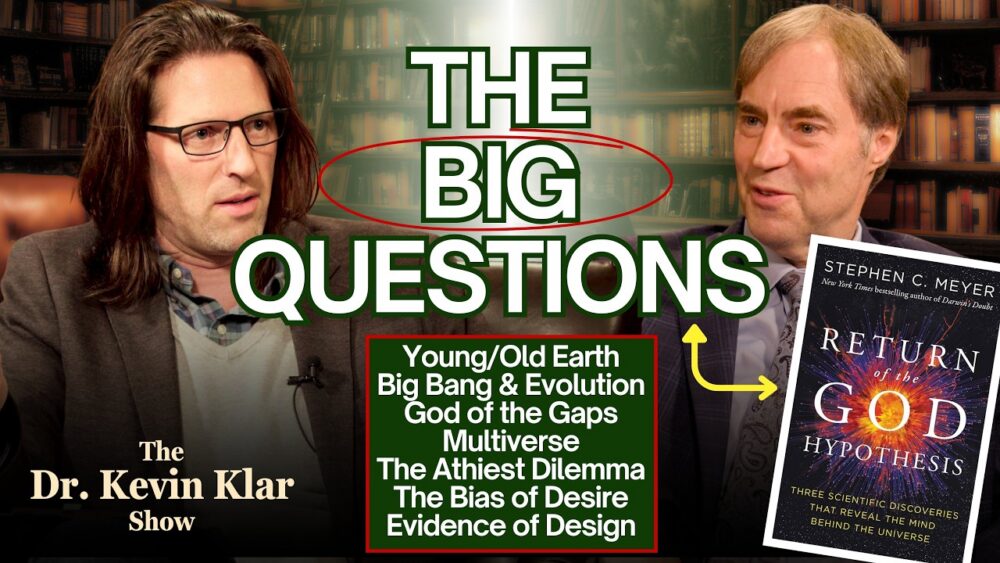
Stephen C. Meyer received his PhD in the philosophy of science from the University of Cambridge. A former geophysicist and college professor, he now directs Discovery Institute’s Center for Science and Culture in Seattle. He has authored the New York Times best seller Darwin’s Doubt: The Explosive Origin of Animal Life and the Case for Intelligent Design (HarperOne, 2013), Signature in the Cell: DNA and the Evidence for Intelligent Design (HarperOne, 2009), which was named a Book of the Year by the Times (of London) Literary Supplement in 2009, and now, Return of the God Hypothesis (HarperOne, 2021).

In his first book on intelligent design, Signature in the Cell: DNA and the Evidence for Intelligent Design (HarperOne, 2009) Meyer examined the mystery of the origin of the first life. With Darwin’s Doubt, he has expanded the scope of the case for intelligent design to the whole sweep of life’s history. Meyer’s research addresses the deepest mystery surrounding the origin of life and the origin of animal life: the origin of biological information necessary to produce it.

Meyer graduated from Whitworth College in Spokane, Washington, in 1981 with a degree in physics and earth science. He later became a geophysicist with Atlantic Richfield Company (ARCO) in Dallas, Texas. From 1981 to 1985, he worked for ARCO in digital signal processing and seismic survey interpretation. In 1986 as a Rotary International Scholar, he began his training in the history and philosophy of science at Cambridge University, earning an M.Phil. in 1987 and a Ph.D. in 1991. His doctoral thesis was titled “Of Clues and Causes: A Methodological Interpretation of Origin-of-Life Research.”

He returned to Whitworth in the fall of 1990 to teach philosophy and the philosophy of science. He left a tenured position as a professor at Whitworth in 2002 to direct the Center for Science and Culture full time, which he had helped found with John West in 1996.

Prior to the publication of Signature in the Cell and Darwin’s Doubt, the writing for which Meyer was best known was an August 2004 review essay in the Smithsonian Institution-affiliated peer-reviewed biology journal Proceedings of the Biological Society of Washington. The article laid out the evidential case for intelligent design, presenting it as the best explanation for the origin of the biological information necessary to produce the new forms of animal life that arose abruptly during the Cambrian explosion.

Because the article was the first peer-reviewed publication arguing for intelligent design in a technical journal, it proved extremely controversial.  The journal’s editor, evolutionary biologist Richard Sternberg, was punished by his Smithsonian supervisors for allowing Meyer’s article into print. This led to the investigation of top Smithsonian personnel by the U.S. Office of Special Counsel.  The controversy was widely covered in the media with articles or news stories appearing about it in The Wall Street Journal, Science, Nature, NPR, The O’Reilly Factor and the Washington Post. The federal investigation eventually concluded that Sternberg had been wrongly disciplined and intimidated.

Meyer’s many other publications include contributions to, and the editing of, the peer-reviewed volume Darwinism, Design and Public Education (Michigan State University Press, 2004) and the innovative textbook Explore Evolution (Hill House Publishers, 2007).

Meyer has also published editorials in national newspapers such as The Wall Street Journal, USA Today, The National Post (of Canada), The Daily Telegraph (of London) and The Los Angeles Times.  He has appeared on national television and radio programs such as The Jim Lehrer News Hour, NBC Nightly News, ABC Nightly News, CBS Sunday Morning, Nightline, Fox News Live, Paula Zahn Now (CNN), Good Morning America and the Tavis Smiley Show on PBS.  He has also been featured in two New York Times front-page stories and has garnered attention in other top national media.

In 2008, he appeared with Ben Stein in the theatrical-released documentary Expelled: No Intelligence Allowed.  He has also been featured prominently in the science documentaries Icons of Evolution, The Case for a Creator, Darwin’s Dilemma and Unlocking The Mystery of Life, the latter which was shown on PBS and which Meyer co-wrote with producer Lad Allen.

Archives

“Atheists Have A Serious Problem” Michael Knowles & Intelligent Design

Stephen C. Meyer joins Michael to discuss the scientific case for intelligent design. Drawing from Signature in the Cell and Darwin’s Doubt, Meyer presents evidence from molecular biology, the Cambrian explosion, and information theory that challenges unguided Darwinian evolution and points to an intelligent cause. He addresses common objections and explores the implications for science and worldview. A clear, evidence-based look at one of today’s most important debates.

Three Scientists on the Origins of Everything | Stephen Meyer, John Lennox, and James Tour

Moving from the Big Bang and the discovery of cosmic beginnings, to the fine-tuning of the physical constants that make life possible, to the extraordinary complexity and information embedded in DNA, mathematician John Lennox, philosopher of science Stephen Meyer, and chemist James Tour, explores whether these developments point to blind, undirected processes—or to the activity of an intelligent mind. The trio challenges long-held materialist assumptions, revisits classic scientific debates, and reflects on what these questions mean not only for science but also for our understanding of human existence and purpose.

Is It Time to Rethink Darwinian Evolution?

Stephen C. Meyer with Matt Fradd on Pints with Aquinas
Matt Fradd interviews Stephen C. Meyer about why he abandoned secular materialism for Christian theism, centering on questions of meaning, morality, and reason. Meyer argues that a purely naturalistic universe cannot give lasting significance to human lives or achievements, which he links to a wider crisis of meaning. If our minds are products of unguided evolution plus matter alone, we lack any good reason to trust them as truth-tracking rather than merely survival-oriented. In contrast, a rational Creator designing both the world and our minds explains why the universe is intelligible and why science works. Meyer also explains why neo-Darwinian mechanisms cannot generate the vast biological information in DNA or the rapid appearance of new forms of life. Meyer argues that theism —

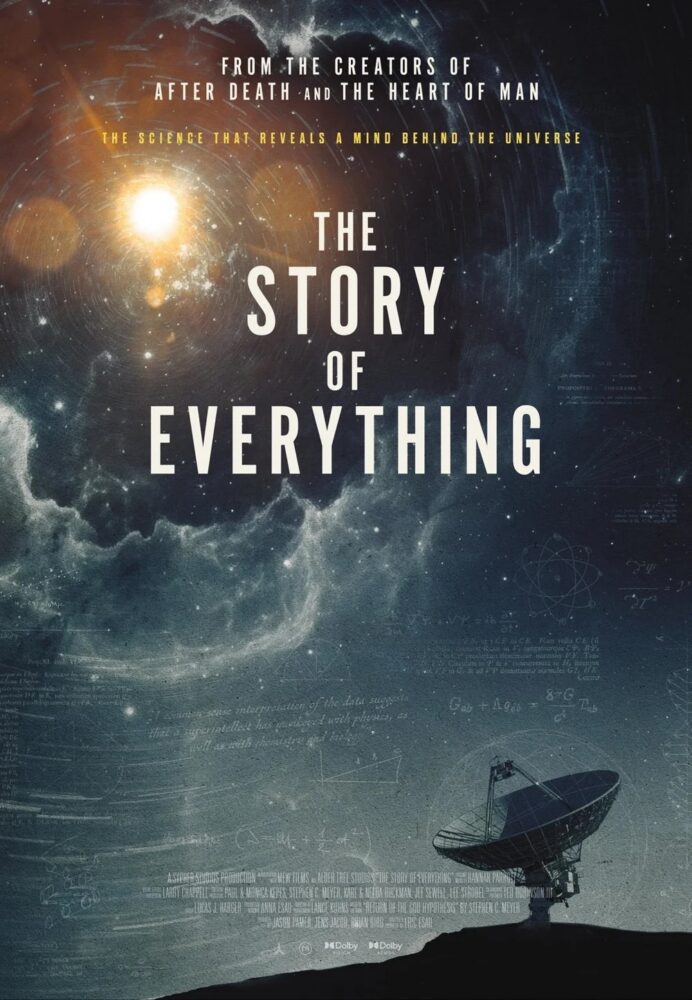
The Story of Everything — Trailer

The Story of Everything is a cinematic exploration of the cosmos that reveals the hidden hand behind our universe. From the precise laws that govern the stars to the intricate patterns found in every living cell, the film traces evidence of intentional design throughout nature. Whether examining distant star-forming clouds or the spiral structure of DNA, we discover a consistent signature woven into the fabric of existence. Website: https://www.thestoryofeverything.film Instagram: @storyofeverythingfilm Facebook: The Story of Everything – Film Twitter/X: @TSOEfilm TikTok: @storyofeverythingfilm Youtube: @Thestoryofeverythingfilm

The Story of Everything — Extended Trailer

The Story of Everything is a cinematic exploration of the cosmos that reveals the hidden hand behind our universe. From the precise laws that govern the stars to the intricate patterns found in every living cell, the film traces evidence of intentional design throughout nature. Whether examining distant star-forming clouds or the spiral structure of DNA, we discover a consistent signature woven into the fabric of existence. Website: https://www.thestoryofeverything.film Instagram: @storyofeverythingfilm Facebook: The Story of Everything – Film Twitter/X: @TSOEfilm TikTok: @storyofeverythingfilm Youtube: @Thestoryofeverythingfilm

The Origin of Animal Body Plans

What produced different animal body plans in the history of life? Scientist and philosopher Stephen Meyer explains why unguided evolutionary mechanisms weren’t sufficient and why animal body plans required intelligent design.

From Fantastic Four to First Causes: Why Science Has Eclipsed Darwin

If you noticed a copy of Charles Darwin’s famous nineteenth-century volume On The Origin of Species in someone's house, what would you think? Perhaps they’re committed materialists. Perhaps they simply admire Darwin’s work as a naturalist. Or perhaps they keep it around as a cautionary tale about the dangers of scientific hubris. Either way, you’d want to consider whether their experiences of the world around them matched their scientific worldview. Today on ID The Future, host Andrew McDiarmid explores the tenets of scientific materialism to see if they match our observations of the world around us. McDiarmid also shares a clip from Dr. Stephen Meyer as he highlights just one of the scientific discoveries of the last century showing that the 19th century science that produced today's scientific atheism has been eclipsed.

From Dead Ends to Design: Meyer & Tour on Life’s Information Code

On today's episode, enjoy the second half of a discussion between philosopher of science Dr. Steven Meyer and synthetic organic chemist Dr. James Tour about the origin of life and the explanatory power of intelligent design. The conversation, hosted by Peter Robinson, transitions from the "dead end" of current origin of life research to the crucial concept of information. This is Part 2 of a two-part conversation. Look for Part 1 in a separate episode. We’re grateful to the producers of Uncommon Knowledge for permission to share this conversation here. Uncommon Knowledge is a production of the Hoover Institution at Stanford University.

The Unsolved Mystery of Life’s Origin: Stephen Meyer & James Tour

How did life originate? Does Darwin’s theory of evolution have an answer for the origin of life? On this ID The Future, enjoy the first half of an insightful conversation between philosopher of science Dr. Stephen Meyer and synthetic organic chemist Dr. James Tour as they unravel important issues around the origin of life. Dr. Tour is a professor at Rice University, renowned for his work in nanotechnology and his skepticism toward the current scientific models explaining the origin of life. Dr. Meyer is author of Darwin’s Doubt: The Explosive Origin of Animal Life and the Case for Intelligent Design. The pair are interviewed by Peter Robinson, host of Uncommon Knowledge. This is Part 1 of a two-part conversation. Look for Part 2 in a separate episode.

“Do You Believe in Evolution?” Stephen Meyer Responds to Joe Rogan

Do you believe in evolution? That’s a good question that could start a very productive conversation about the origin and development of life on Earth. But the first steps are clarifying what the word “evolution” actually means and why unguided evolutionary processes are limited in power and scope. Today, host Andrew McDiarmid invites you to revisit a segment from Dr. Stephen Meyer's 2023 interview with Joe Rogan. Meyer answers Rogan's probing question comprehensively. Yes, he tells Rogan, he believes in “real evolutionary processes,” but he also believes in the limitation of those evolutionary processes, and he takes several minutes to unpack and explain some of the challenges the standard neo-Darwinian account of life faces today. McDiarmid follows up by summarizing Meyer's response and sharing excerpts from Meyer's book Darwin's Doubt to explain the importance of Meyer's arguments to the debate over evolution.