

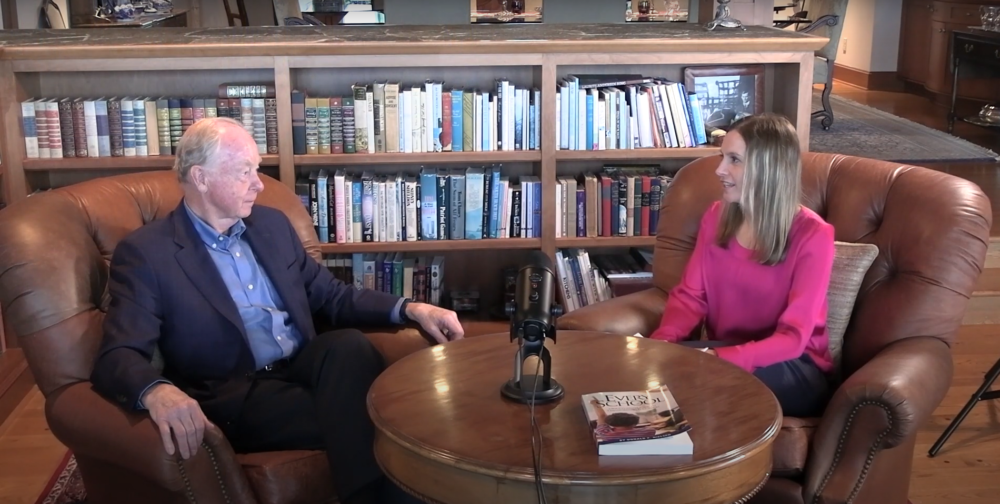



By now, you’ve likely heard of the new documentary film The Story of Everything. It’s a cinematic exploration of the evidence for intelligent design in the cosmos, from the fine-tuning of the universe to the stunning engineering in every living cell. Today on ID The Future, we continue our series of interviews with the scientists and scholars featured in The Story of Everything. Host Andrew McDiarmid welcomes plasma physicist Dr. Robert Sheldon to the podcast to discuss his participation in the movie and talk about his work in physics and cosmology.
If we believe there is no qualitative distinction between animals and humans, are we more likely to protect human life or devalue it? On this episode of ID The Future out of the vault, guest host Eric Anderson talks to historian Dr. Richard Weikart about his latest book, Unnatural Death: Medicine’s Descent From Healing to Killing, now available from Discovery Institute Press. The book is a wide-ranging history of euthanasia and assisted suicide from Ancient Greece to today. How did we get to the point we are at today, and how do we turn the tide to promote the sanctity of human life? Tune in to find out.
Most people know about the two atomic bombs dropped on Japan in 1945. But Robert Oppenheimer’s Manhattan Project had on hand another nuclear core. After claiming the lives of two scientists in separate accidents, it was dubbed the Demon Core and melted down. Some demons, however, are not so easily destroyed. Today, guest host Jonathan Witt concludes his conversation with medical doctor, disaster prep expert, and novelist Geoffrey Simmons about his new thriller novel Oppenheimer’s Demon, now available from Discovery Institute Press. This is Part 2 of a two-part conversation.
On this bingecast archive episode of Mind Matters News, guest host Pat Flynn welcomes Dr. Winston Ewert to the show to discuss Ewert’s chapter in the volume Minding the Brain.
In his contribution, titled “The Human Mind’s Sophisticated Algorithm and Its Implications,” Dr. Ewert argues that the human mind’s problem-solving cognition can be modeled as a sophisticated algorithm. Ewert explains that any cognitive task can be expressed as a version of the halting problem from computer science, where an algorithm either halts or continues infinitely. He suggests that humans are able to solve a large and sophisticated subset of these problems, but are limited in the same way that no algorithm can solve all halting problems. Ewert contends that this algorithmic view of human cognition has implications that challenge reductive materialist and neo-Darwinian views, despite resistance from some thinkers who believe human abilities transcend any algorithm.
On this episode of the Mind Matters News podcast, guest host Pat Flynn welcomes Dr. Robert Marks and Dr. Michael Egnor to the show to critique Integrated Information Theory (IIT), a popular mathematical model that attempts to explain consciousness through computational complexity.
The age of AI is upon us and is already changing the way we conduct our lives. What is the optimal division of tasks between humans and machines? On this episode of Mind Matters News, host Robert J. Marks welcomes psychologist Dr. Joe McDonald to the podcast to explore the relationship between cognitive psychology and artificial intelligence (AI). Dr. McDonald is an expert in cognitive psychology and human factors research. He is the CEO and Principal at Jumpseat Research, a firm that applies cognitive science principles to improve technology design and user experiences. Dr. McDonald has over 15 years of experience in this field, holds a PhD in Human Factors from Georgia Tech, and is passionate about empowering people through technology.